
EXPLORE GREAT NORTH VIETNAM IN 14 DAYS
Great North loop in 14 days / 13 nights.
Great North Ride Introduction
Vietnam Motorbike & Motorcycle Tours offers this exciting Great North motorbike ride for riders who want to explore a complete loop through the mountains of Northern Vietnam. This adventure is designed primarily for intermediate and advanced riders, although less experienced riders can take a riding lesson in Hanoi before joining the trip.
On this Northern Vietnam motorcycle adventure, you will ride through some of the region’s most spectacular high mountain roads. Depending on the route, the journey can take you through the dramatic mountains of the Northwest via Sapa or across the spectacular Dong Van Karst Plateau Geopark in the Northeast. Along the way, you will meet friendly and colorful ethnic communities and experience a rich mixture of cultures, traditions, and lifestyles.
The combination of challenging mountain roads, spectacular scenery, remote villages, and authentic cultural experiences makes the Great North Loop one of our most rewarding Vietnam motorbike adventures. It is the kind of journey that stays with you long after you return home.
Below is a video clip containing some portions of this Great North Ride. If you would like to watch more videos from our Vietnam motorbike tours and adventures, please visit and subscribe to our YouTube channel.
GREAT NORTH LOOP DETAILED ITINERARY
Day 1: Hanoi – Mai Chau. (~170 km, ~5 hrs)
We leave Hanoi on National Road 6, heading southwest towards Mai Chau, an idyllic mountain valley inhabited mainly by the White Thai ethnic group. Visiting Mai Chau allows us to experience the traditional culture and colorful lifestyle of the local White Thai people.
The approach to Mai Chau is particularly scenic, with dramatic limestone mountains, green valleys, and ethnic villages along the route. Along the way, we also have opportunities to learn more about the traditional agricultural lifestyle of communities living around the Red River Valley and Da River.
After lunch, we have the afternoon to explore the area and ride up towards the top of Thung Nhuoi Pass. From the summit, there is a spectacular panoramic view over Mai Chau Valley. Sometimes the mountains are covered by clouds or mist, but this can make the scenery even more atmospheric.
After visiting the pass, we descend into the valley and continue exploring the villages and surrounding countryside inhabited by the White Thai people.
In the evening, we enjoy a local dinner and overnight stay in a beautiful village beside the river. After dinner, you can relax around a traditional fire and enjoy a Thai cultural music and dance performance.
Wearing their traditional costumes, local Thai women invite visitors to participate in the Xoe dance, a traditional group dance performed hand-in-hand to lively music. Between dances, guests can sample ruou can, a traditional sticky-rice rice wine shared through bamboo straws.
Dancing together around a fire in a remote mountain village is a unique experience, and for many riders it becomes one of the most memorable evenings of the entire Great North motorbike tour.
Day 2: Mai Chau – Thung Man. (100 km, ~4 hrs)
This is one of the most relaxing days of the Great North motorbike ride, with a relatively short distance but plenty of opportunities to experience remote mountain scenery and local life.
Today, we continue deeper into Northern Vietnam by following the old National Highway 6. This historic road was poorly maintained for more than 20 years, leaving many sections narrow, rough, and bumpy. The road winds across numerous mountain ridges, making the ride more challenging and keeping traffic to a minimum.
In some places, the road is almost deserted. If we are lucky, we may encounter a horse-drawn or buffalo-drawn cart, but otherwise there may be very little traffic around us. This isolation gives us a wonderful opportunity to experience a quieter and more traditional side of Northern Vietnam.
Along the way, we meet people from several ethnic communities, including the Red Dao, Dao Tien, Muong, and Thai. Many families here maintain a simple mountain lifestyle based on growing rice, vegetables, and fruit at higher elevations. Traditionally, hunting in the surrounding forests has also been part of local life.
Around midday, we stop for lunch at the top of a mountain pass, where we can enjoy magnificent views across the Moc Chau grasslands and the Da River.
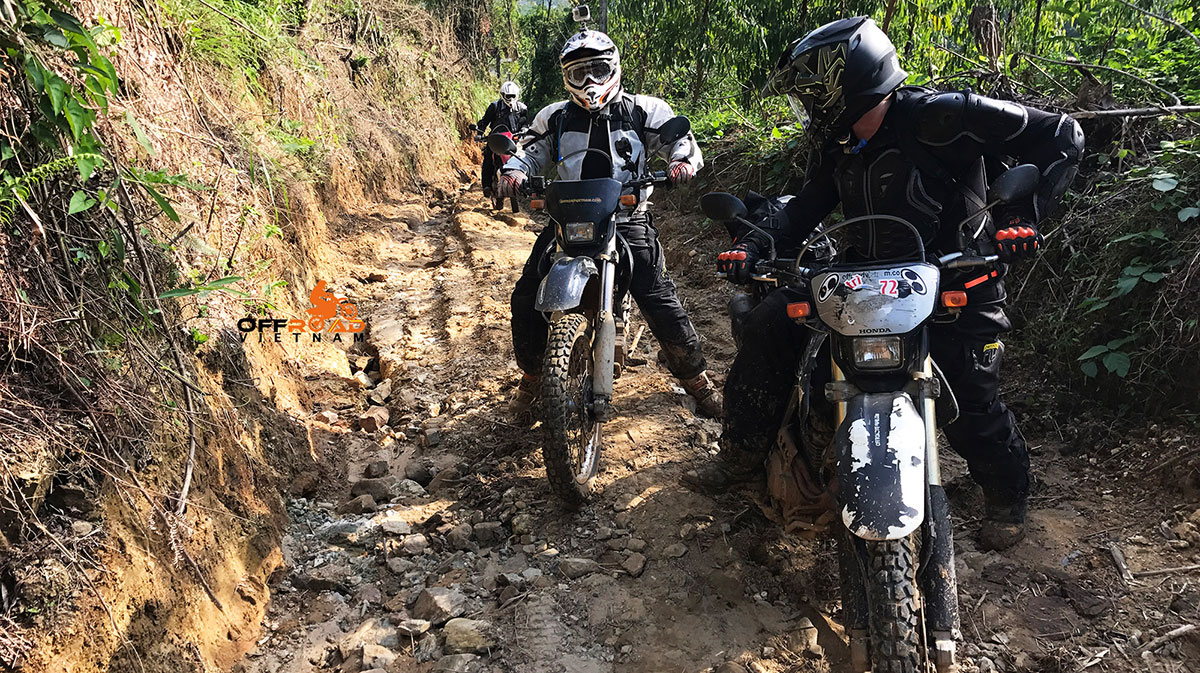
The afternoon becomes more challenging. After leaving the newer section of Highway 6, we turn onto a rougher and more tortuous mountain road. The surface can be bumpy and demanding, but the effort is rewarded by spectacular mountain scenery and opportunities to experience the distinctive culture and traditions of the H’mong people.
For riders who enjoy getting away from the main roads, this section captures the true spirit of a Northern Vietnam off-road motorcycle adventure – remote roads, rugged mountains, small communities, and very few other travelers.
Day 3: Thung Man – Phu Yen. (130 km, ~4 hrs)
After breakfast and saying farewell to our hosts, we visit Thung Mai, a timeless H’mong village located at an altitude of more than 1,000 meters above sea level in a remote and rugged mountain area. The H’mong people have lived here for nearly 100 years. According to local history, some H’mong families moved into this remote area while fleeing towards Ha Giang during the period of French colonial rule.
Reaching Thung Mai takes approximately one and a half hours of riding to the top of the mountain. When we arrive, we find a small and beautiful village of around 20 houses, many of them built from stone, surrounding a tiny, almost fairy-tale-like pond on the mountaintop.
The village feels remarkably isolated from the modern world. There are no busy roads, traffic, or karaoke bars here. Instead, the local people have preserved many of their traditional customs, culture, and way of life. Visiting this remote H’mong community offers a rare opportunity to experience a much quieter side of Northern Vietnam.
After lunch, we have the afternoon to explore the dreamlike Moc Chau grasslands. This beautiful highland region combines spectacular scenery with a cool and often cloudy climate. Located in the Northwest mountains, Moc Chau is known for its forests, tea plantations, fruit-growing hills, and open green landscapes.
We can also take a walk to visit local dairy farms and learn more about the region’s dairy industry. Dairy products are one of Moc Chau’s specialties and are produced locally for markets both in Vietnam and beyond.
After exploring the area, we descend towards the Da River and take a specialized boat across the river. From there, we continue riding along the river towards Phu Yen Valley, one of the most beautiful and prosperous areas inhabited by the Thai people in Northwest Vietnam.
Day 4: Phu Yen – Tuan Giao. (210 km, ~6 hrs)
Our journey north continues towards Son La, following Highway 113 through spectacular mountain scenery. Along the way, we pass green valleys, rice terraces, and mountain communities scattered across the landscape.
After crossing the mountains around Bac Yen, we continue through Chen Pass and into an area known for its extensive maize and manioc cultivation before reaching the Son La Plateau.
After lunch in Son La town, we visit the former French Prison and Provincial Museum, providing an opportunity to learn more about the region’s history and Vietnam’s struggle for independence.
We then continue our journey through a succession of impressive mountain passes, including Son La Pass, Chieng Pac Pass, and Pha Din Pass. The riding becomes increasingly scenic as we climb and descend through the mountains towards the Dien Bien Phu region.
In the afternoon, we have time to climb to the top of Pha Din Pass, one of the most spectacular mountain passes in Northwest Vietnam. The name Pha Din is associated with the meeting of heaven and earth, and the views from the summit help explain why.
Pha Din forms a natural boundary between Son La and Dien Bien provinces and is located in the region associated with the decisive Battle of Dien Bien Phu in 1954, an important event in Vietnam’s struggle for independence.
After enjoying the mountain scenery, we continue to Tuan Giao, arriving in time to watch the sunset over the surrounding mountains.
Day 5: Tuan Giao – Sin Ho. (150 km, ~5 hrs)
Today we continue deeper into Northern Vietnam, riding the remaining section of the historic Highway 6. The road can be rough and demanding, but the spectacular scenery makes the effort worthwhile.
The route crosses a series of high mountain passes, with steep slopes rising above the Da River as it winds around the base of the mountains. This combination of dramatic peaks, winding roads, river valleys, and remote villages creates some of the most impressive riding scenery on the Northwest route.
One of the simple pleasures of traveling by motorcycle in this region is meeting local people along the way. Friendly smiles and waves from people in remote villages make the long riding days even more enjoyable.
We stop along the route to meet members of several ethnic communities, including the Black Thai, Kho Mu, Lu, Black H’mong, Green H’mong, and White H’mong. These are just some of the many ethnic groups who have made their homes in the mountains of Northwest Vietnam.
We have time to discover their traditional lifestyles, colorful clothing, customs, and cultures before continuing towards Lai Chau.
After lunch in Lai Chau, we take a boat along the Nam Na River. The journey takes us past steep cliffs and dramatic rock formations, with small villages and green rice fields spread across the hillsides on either side of the river.
The boat is relatively small, but the experienced local boatman knows the river well and makes the journey both safe and adventurous. After the river trip, we continue by motorcycle towards Sin Ho, our destination for the evening.
Day 6: Sin Ho – Tam Duong – Sapa. (110-170 km, ~4-5 hrs)
Located at an altitude of around 1,700 meters, Sin Ho is one of the most remote and challenging destinations on this route. The difficult terrain and high elevation have helped preserve many traditional ways of life, and local communities have maintained customs and lifestyles that have changed little over generations.
Only relatively few travelers make it this far into the mountains, which makes Sin Ho a particularly rewarding destination for adventurous motorcycle riders. The local mountain market is famous for its colorful atmosphere, where people from different ethnic communities gather wearing their traditional clothing.
Depending on the day, we may encounter members of the Green H’mong, Black H’mong, White H’mong, Dzao Dau Bang, and Lu communities. Their traditional clothing, customs, and distinctive lifestyles add incredible color and character to this remote mountain region.
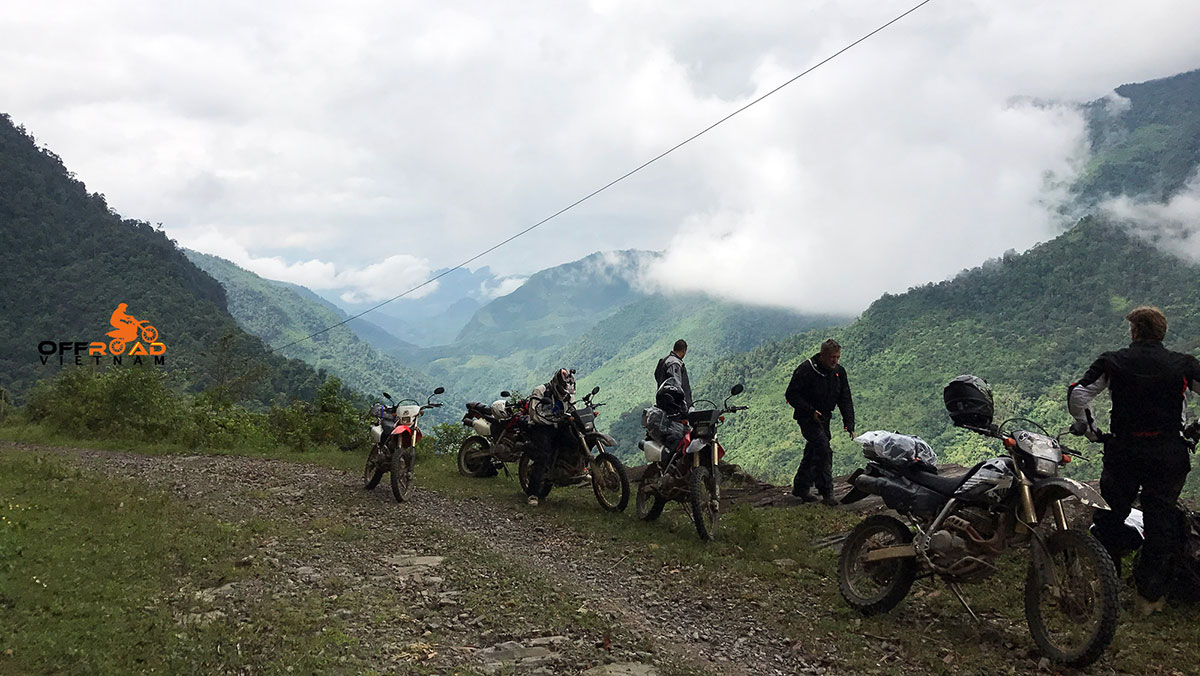
We then continue towards Tam Duong and Sapa, stopping for a picnic lunch at the top of Tram Ton Pass, one of the most spectacular mountain passes in the Sapa area. From the pass, the views across the Hoang Lien mountain range can be breathtaking, particularly when the clouds begin to move through the valleys below.
In the afternoon, we have free time to explore Sapa, a mountain town that is often surrounded by clouds and mist. After enjoying a cup of local artichoke herbal tea, we can take a walk around town and meet some of the local people who give this area its distinctive character.
Sapa was established as a hill station during the early years of the 20th century under the French administration and soon became known throughout Indochina for its cool climate. Today, the surrounding mountains, valleys, rice terraces, and ethnic villages make Sapa one of the most spectacular destinations in Northern Vietnam and Southeast Asia.
Day 7: Sapa – Bac Ha – Xin Man. (~140 km, ~4 hrs)
In the morning, we descend from Sapa to Lao Cai and visit the Lao Cai border gate with China. From there, we follow Route 70 towards Bac Ngam, stopping along the way to enjoy the beautiful mountain and river scenery and take some photographs.
We then turn towards the mountains and ride up to Bac Ha, where we stop for lunch. Afterward, we take a short hike to explore some of the surrounding H’mong villages and learn more about the traditional lifestyle of the local communities.
In the afternoon, the ride becomes considerably more challenging as we leave the main roads and follow a small, rough trail towards Xin Man. The route passes through remote and rugged mountain terrain, with sections that can become extremely muddy and slippery during the rainy season.
This is one of the more challenging sections of the Great North motorbike adventure, comparable in difficulty to some of the rough trails around Pu Luong, Muong Lay, and That Khe. For riders who enjoy technical terrain and remote mountain roads, this section provides a genuine Northern Vietnam off-road riding experience.
Day 8: Xin Man – Thac Ba. (~170 km, ~6 hrs)
This special day of the Great North Loop begins by heading south on a rough, bumpy, and sometimes muddy mountain road. Fortunately, after climbing towards the top of the mountain, the road improves, and we can enjoy a fantastic descent through the highlands.
The scenery is spectacular, with rice terraces and paddies covering the mountainsides. During the rainy season, some sections can become extremely difficult, turning the ride into a real test of motorcycle control and riding technique.
Along the way, we stop at several remote villages to meet local people, chat with them, and learn more about their traditional cultures and everyday lives.
After approximately three hours of riding, we reach a better but still relatively small and quiet mountain road. This section provides excellent riding through the countryside, passing rice fields and the limestone karst mountains around Luc Yen.
After lunch, we continue for another approximately 60 km towards a beautiful lakeside village inhabited by the Dao Quan Trang people. We leave our motorcycles safely in the village and board a small boat to explore the lake. If conditions are suitable, there is also time for a refreshing swim before we settle in for the evening.
Day 9: Thac Ba – Ba Be. (~160 km, ~5 hrs)
We leave Thac Ba Lake and follow scenic roads through green tea plantations and traditional villages towards Tuyen Quang. After reaching the town, we join National Highway 2 for around half an hour.
The highway is not particularly interesting for motorcycle riding, so we soon turn off onto smaller and wilder mountain roads. The route takes us through forested hills and remote countryside before eventually reaching Ba Be National Park and Ba Be Lake.
Ba Be is one of the highlights of the Great North motorbike tour. In the evening, we stay with a local Tay family, where we can enjoy a peaceful rural setting surrounded by limestone mountains and rice fields overlooking the lake.
The homestay provides a wonderful opportunity to experience traditional local life while enjoying one of the most beautiful natural landscapes in Northern Vietnam.
Day 10: Ba Be – Bac Me – Ha Giang. (~130 km, ~5 hrs)
We start early in the morning by loading our motorcycles onto a boat for an approximately two-hour journey across Ba Be Lake and Ba Be National Park. After cruising through the spectacular scenery, we land near a maize field, unload the bikes, and have breakfast at the Nang River restaurant.
The restaurant owner, Mr. Pirrate, can also provide useful local advice before we begin what will be one of the most challenging riding days of the Great North adventure.
The first section involves approximately 3 km of riding along an old hillside trail beside the Nang River. The trail is relatively spacious and gives us a chance to warm up before the terrain becomes considerably more demanding.
Then it is time to put your riding skills, technique, and experience to work. We enter approximately 80 km of forest roads with numerous junctions and branching trails. Without an experienced local guide, it would be easy to take the wrong route among the many branches.
The road climbs over numerous high passes and descends into deep river valleys. During the dry season, this section can take approximately three to four hours, while heavy rain can turn it into a seven- or eight-hour adventure.
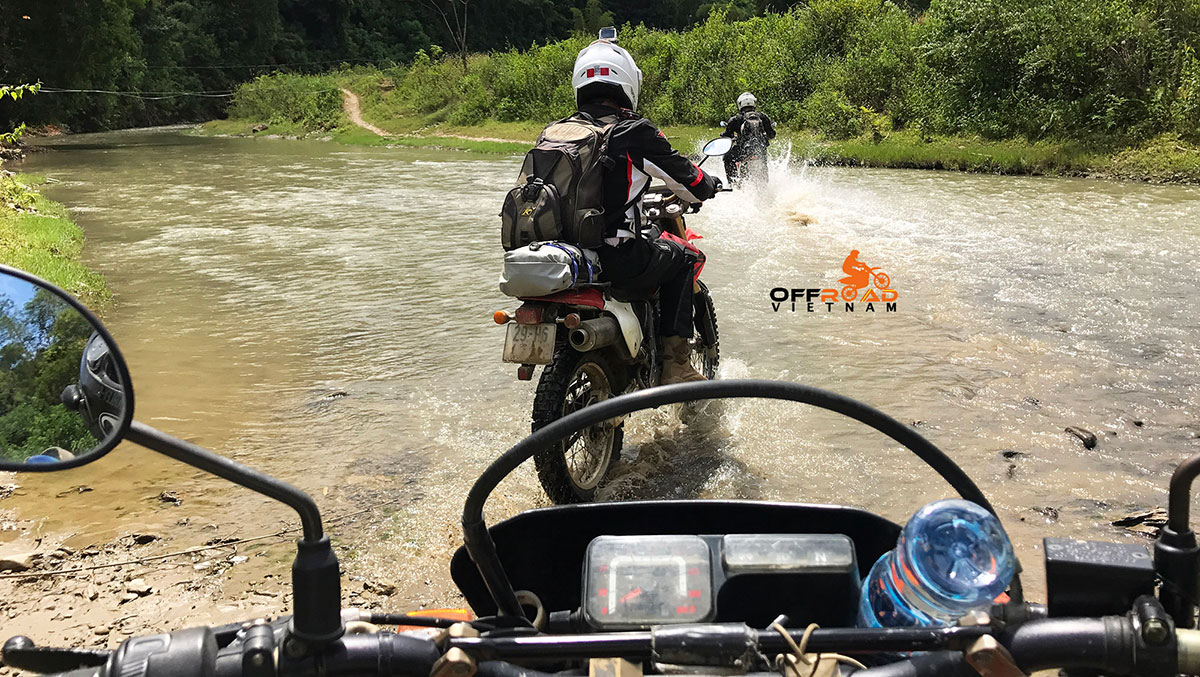
The terrain can be demanding, but the feeling of conquering the wilderness on a motorcycle makes the effort worthwhile. Along the way, we cross three rivers, each approximately 20-30 meters wide but only around 70 cm deep. Our experienced guides provide instructions to help riders negotiate these crossings safely.
The final 50 km towards Ha Giang is considerably easier, although there are still several mountain passes to cross before reaching the city.
Day 11: Ha Giang – Meo Vac. (~160 km, ~4 hrs)
This is probably one of the best days of the entire Great North motorbiking adventure.
We rise early and explore the spectacular mountain scenery around the Heaven Gates, including Quan Ba, Yen Binh, and the route towards Dong Van. The name “Heaven Gate” seems particularly appropriate as the road climbs high above the valleys, giving the impression that you are riding towards the sky.
This is one of the best places to appreciate the enormous limestone mountain ranges and near-vertical rock walls of the Dong Van region. The landscape is dramatic, rugged, and almost otherworldly, creating the feeling of riding through a magical mountain wilderness.
We are surrounded by rocks of every shape and size as the road continues through the Dong Van Karst Plateau. After lunch in Yen Minh, the scenic route climbs another mountain pass before reaching Pho Bang, a historic town known for its traditional multi-story houses built from clay bricks with tiled roofs.
We visit some of our local friends from the Hoa community before continuing to the famous Vuong Family Palace.
The palace belonged to a powerful H’mong family during the French colonial period. Vuong Chi Sinh was regarded as the H’mong King of the region, and his former residence remains one of the area’s most interesting historical attractions.
The palace is particularly fascinating for visitors interested in architecture because it combines elements of European and Chinese architectural styles with traditional local design.
After exploring the area, we continue to Meo Vac, where we spend the night.
Day 12: Meo Vac – Quang Uyen. (~170 km, ~6 hrs)
After saying farewell to Meo Vac, we climb over the spectacular Ma Pi Leng Pass, one of the most famous mountain passes in Northern Vietnam. From the high viewpoints, we can look down towards the dramatic Nho Que River winding through the limestone mountains below.
Traveling through these remote areas gives us a powerful insight into how difficult life can be for people living among the rocky mountains. There is very little arable land, and the harsh environment makes farming extremely challenging.
For generations, local communities have relied heavily on corn, one of the few crops capable of growing in the rocky soil. Despite the difficult conditions, the people of these mountains are remarkably friendly and welcoming. Their strong sense of community and connection to the land is an important part of the character of this remote region.
We continue following the river until reaching RC 4C, close to the Chinese border. We then cross the Gam River on a traditional bamboo raft and enter Cao Bang Province.
Along the way towards Bao Lac, we encounter several ethnic communities, including the Lo Lo, Bo Y, Dao, and Giay, with villages located close to the road. These encounters provide another opportunity to experience the remarkable cultural diversity of Northern Vietnam.
We continue on a good section of RC 4, passing the scenic Pac Lung Pass, before reaching the Nguyen Binh Valley, where green maize and rice fields contrast beautifully with the surrounding limestone mountains.
From there, we continue over increasingly wild mountain passes towards Cao Bang. After lunch, we take a short walk around the town to discover some of the remaining traces and stories from the French colonial period and the events of the 1940s.
Cao Bang has several important historical sites, and we have time to explore some of them before continuing towards Ma Phuc Pass. Beyond the pass, the landscape changes dramatically again, with vast and steep limestone karst formations dominating the horizon.
We enter the northern and northeastern districts, an area traditionally inhabited by Nung and Tay communities, bringing another memorable day of mountain riding, spectacular scenery, and cultural discovery to the Great North Loop.
Day 13: Quang Uyen – That Khe. (~120 km, ~4 hrs)
Ride down from the spectacular karst mountains of Northeast Vietnam and spend a full day exploring the history of the legendary National Road 4 (Route Coloniale 4), made famous by the battles of the 1950s.
This section of the Great North Vietnam motorbike tour combines beautiful mountain scenery with some of the most important historical sites in the region. We visit the historic battlefields of That Khe and Dong Khe, where major battles took place during the First Indochina War.
Despite being one of the most scenic days of the Great North Vietnam motorcycle trip, today’s route can be quite demanding, with winding mountain roads, changing terrain, and plenty of challenging riding. It is a rewarding final adventure through the remote landscapes of Northern Vietnam.
Day 14: That Khe – Hanoi. (~230 km, ~6 hrs) End of Great North motorbike trip.
Today, we take the easier road back to Hanoi, enjoying a more relaxed ride after the demanding mountain sections of the Great North loop.
Along the way, we pass through numerous peaceful villages of the Tay ethnic people, often surrounded by green rice fields and tucked beneath the foothills. We aim to arrive in Hanoi before the afternoon rush hour, preferably before 4 pm, allowing enough time to finish the journey comfortably.
After 14 days of riding through remote mountain roads, ethnic villages, spectacular passes, karst landscapes, and historic sites, we complete this unforgettable 14-day Great North Vietnam motorbike tour on two wheels.
Contact us at [email protected] for more details, availability, and options for other Great North Vietnam motorbike tours and Northern Vietnam motorcycle adventures.
Other Popular Itineraries For Motorbike Tours Through Vietnam
- Ha Giang and Northeast
- Mai Chau & Pu Luong
- Middle North
- Northwest
- Northeast
- Ho Chi Minh Trail
- Day Tour
- Custom Tours

Leave A Comment